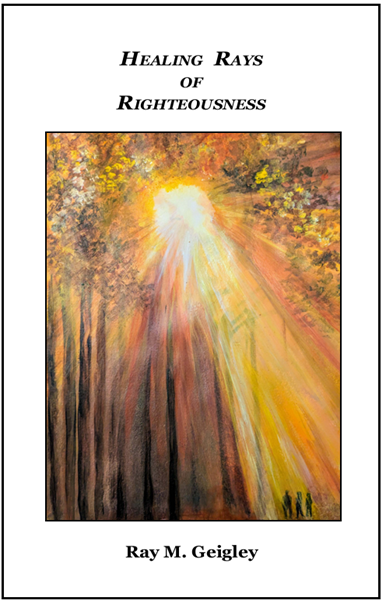
"But for you who revere my name, the sun of righteousness will rise with healing in its rays. And you will go out and frolic like well-fed calves." – Malachi 4:2

Many years ago, before there were electric lights, the poet, Robert Louis Stevenson, looked out his window one evening and saw the town lamplighter coming down the street, lighting the streetlamps in succession. Stevenson was impressed by the sight and authored a poem about the lamplighter who went along “punching holes in the darkness.” 

Many more years before Robert Louis Stevenson, the Gospel writer, John, records Jesus saying, “I am the light of the world. Whoever follows me will never walk in darkness but will have the light of life.” (8:12).And then in Matthew’s account, we hear Jesus saying to his disciples, “You are the light of the world.” (5:14).

What does this imagery of being “light” mean to you? What do you think Jesus intended to illustrate to us? Could it be that Jesus used this imagery to illustrate the purpose and behavior he expects from his followers? I think so and suggest we consider the following works of light.

Light Reveals. It penetrates darkness and makes known what lies hidden in the darkness. Light shows the path or road, giving both direction and the condition of the way ahead, and warns of obstacles and danger. Light reveals both the good and the bad, truth and lie, beauty and ugly. As followers of Jesus, being light means we penetrate the world’s darkness and make known God’s presence, God’s truth, God’s will. Being light means we bring certainty, direction, purpose, and meaning into our communities of confused and hopeless neighbors.

Light Warms. It penetrates coldness. Like the sun’s warmth, light radiates an invitation to enjoy beauty and warm comfort. As followers of Jesus, being light means we are to be a warm, comforting presence, radiating God’s glowing lovein a world of lonely coldness. Being light means we are Christ’s presence in the school, business, shop, and marketplace, revealing to all that there is more to life than selfish greed and deadly individualism.

Light Awakens. It penetrates sleep. Each morning, we are awakened to a new day with its new possibilities. As followers of Jesus, being light means we awaken people to the reality of God’s Kingdom being present, and that his Lordship over all of his creation is the only source of ultimate truth, power, and hope for any and all of us.

Light Energizes. It penetrates depression and decay. We cannot physically live without light. It takes light to stimulate and encourage growth and healing. And so, as followers of Jesus, being light means we infuse and stimulate aliveness and growth, encouraging healing and hope in communities plagued by dark depression and hopelessness.

Furthermore, Jesus tells us that the purpose of light is both to be seen and to be of service to others. This visibility and service is expressed by Jesus with two illustrations, “A town built on a hill cannot be hidden. Neither do people light a lamp and put it under a bowl. Instead they put it on its stand, and it gives light to everyone in the house.” (Mt. 5:14-16).

There can be nothing secretive or private about the Christian’s commitment to the Jesus way of life. The disciples of Jesus do not hide in fear or seek to protect self but instead live and work in places where their influence can be both seen and felt. Being light means we are a visible witness to the presence of the Kingdom of God and the rule of Christ in our world of darkness.

Yes, it is our gracious privilege and supreme duty as Jesus followers, to live each day being the community lamplighter going about. “punching holes in the darkness” so that others may see God and find their way home to God and his Kingdom. Amen!

<><><><><> 

Ray M. Geigley – “Healing Rays of Righteousness” www.geigler13.wordpress.com – 10/08/25

Jesus Remembers Our Name

It has always been difficult for me to remember the names of persons I have previously met, and am too embarrassed to say, “I need to ask, what is your name?”  And so, I often find it easier to continue conversation with someone without asking or speaking their name.

My reluctance in asking a person their name is because I fear the individual may think that their previous acquaintance and conversation with me was not of importance and value to me. Believe me, nothing is further from the truth. I know that there is no better sound than the sound of your own name being spoken and addressing you, and so, deeply regret my inability to quickly remember names.

I am reminded of this every time I read the first eighteen verses of John 10, where Jesus likens himself to a shepherd and us as his sheep. A first-century Palestinian shepherd lived with his sheep. He knew his sheep; he named his sheep; and each morning he would come to the sheepfold and “He calls his own sheep by name and leads them out.” (v.3).Then in verse fourteen, Jesus declares, “I am the good shepherd; I know my sheep and my sheep know me – just as the Father knows me and I know the Father – and I lay down my life for the sheep.” 

It is so wonderful and reassuring for me to know that in the eyes and heart of Jesus, I am much more than a social security number or picture on a driver’s license. Jesus sees me as a person of great worth with a name. And like a good shepherd, Jesus knows my name and cares so deeply about me that he is willing to die for me.

And, according to Isaiah 49:15-16, God promises never to forget my name; “Can a mother forget the baby at her breast and have no compassion on the child she has borne? Though she may forget, I will not forget you! See, I have engraved you on the palms of my hands; your walls are ever before me.”

And earlier in Isaiah 40:11, God told Isaiah to shout out to the people that, “He tends his flock like a shepherd; He gathers the lambs in his arms and carries them close to his heart; he gently leads those that have young.” (Isaiah 40:11). This is such a wondrous, comforting, and reassuring thought!

Furthermore, in Psalm 139, we hear David declaring that God knows about all our daily activities, circumstances, thoughts, and groaning laments, even before we speak them. In this psalm, David stands in awe before the Lord and is astounded by how thoroughly and intimately the Lord knows him. And then in verse seventeen, we hear David gratefully praising God, saying “How precious to me are your thoughts, O God! How vast is the sum of them!”

Yes, in Jesus, you and I have an ever-loving, all-powerful shepherd, who calls us by name and daily provides and protects us. “Even though I walk through the darkest valley, I will fear no evil, for you are with me; your rod and your staff, they comfort me.” (Psalm 23:4).

So be encouraged, my friend, even if I forget your name, God remembers and loves to speak your name, inviting you to come near to him for loving embrace, protection, and provision.

And, yes, I know that someday my memory of names will be as perfect as God’s.

<><><><><> 

Ray M. Geigley – “Healing Rays of Righteousness” www.geigler13.wordpress.com – 10/02/25

Thousands are dying every day, and with each death, there is a community of family and friends deeply grieving and silently groaning. It is difficult for me to fully fathom the immensity and depth of pain being felt among us as a church community and nation, let alone trying to imagine the worldwide experience of pain. We ask, why all this groaning and pain?

The first chapters of Genesis tell us the story of God creating our earth with all its creatures and then us. We are told that “God saw all that he had made, and it was very good.” But then in chapter three we are told the sad story of humanity’s disobedience and the breaking of a good relationship with God.

And from that broken relationship between the created and the Creator flows all the pain-filled groanings of our present world. The harmony of creation and humanity with its Creator is broken, and this dramatically changes the relationship of God with his good creation.

In his book, “Soli Deo Gloria, A Daily Walk Through Romans” Myron Augsburger states that “The world was designed for human life, in God’s good creation, and when humanity rebelled against God, to have its own, the whole world suffered the consequences.” (p.189).

And according to the apostle Paul, the groanings of humanity and all creation are the painful expressions of a frustrated longing for God’s deliverance from the miserable sufferings of this life. “For the creation was subjected to frustration, not by its own choice, but by the will of the one who subjected it, in hope that the creation itself will be liberated from its bondage to decay and brought into the freedom and glory of the children of God.  We know that the whole creation has been groaning as in the pains of childbirth right up to the present time. Not only so, but we ourselves, who have the firstfruits of the Spirit, groan inwardly as we wait eagerly for our adoption to sonship, the redemption of our bodies. For in this hope we were saved.” (Romans 8:19-24).

Just as all creation, humankind, animals, plants, and the earth itself was harmed by humanity’s sinful disobedience, so also will all share in the blessings of redemption and restoration that God has promised his people. “For in this hope we were saved.”

If we believe this, then our groanings become expressions of our redemptive hope, which is based on the sure confidence that God’s promise of restoring us with all of creation to its full harmony and wholeness, is now happening and will one day be fully completed.

Furthermore, Paul reassures us that we do not groan and suffer alone. “In the same way, the Spirit helps us in our weakness. We do not know what we ought to pray for, but the Spirit himself intercedes for us through wordless groans. … the Spirit intercedes for God’s people in accordance with the will of God.” (Romans 8:26-27).

What a marvelous comfort. We are not alone. God’s Spirit prays for us, interceding in our behalf. Because I cannot fully know or express my feelings, the Spirit intercedes for me with “wordless groans” according to the will of God.

And so, I can choose to groan and lament as a way of deepening my relationship with God rather than silently enduring the pain and slowly grow bitter in spirit.

Furthermore, we are assured that God’s hears our groanings. Isaiah 63:7-9 speaks of God’s relationship with his people, and says, “In all their distress he too was distressed, and the angel of his presence saved them. In his love and mercy he redeemed them; he lifted them up and carried them all the days of old.”              Thanks be to God!

<><><><><> 

Ray M. Geigley – “Healing Rays of Righteousness” www.geigler13.wordpress.com 9/24/25

The Love of God

From early childhood I have enjoyed singing “Jesus loves me, this I know, for the Bible tells me so.” And during the many years since, I have always been spiritually energized with singing the hymn written by Frederick M. Lehman, “The love of God is greater far than tongue or pen can ever tell, it goes beyond the highest star and reaches to the lowest hell.”

This hymn is rich in describing God’s love as “measureless,” “strong,” and will “evermore endure.” And yet there are the tough times when I am tempted to feel uncertain about God’s love? During those days, I am encouraged by the words of the apostle Paul in his letter to “God’s holy people in Ephesus.” Paul’s encouraging message seems to me to give roots and life to the above songs about God’s love.

He begins his letter with this reassurance; “For he chose us in him (Christ) before the creation of the world to be holy and blameless in his sight. In love he (God) predestined us for adoption to sonship through Jesus Christ, … In him (Christ) we have redemption through his blood, the forgiveness of sins, in accordance with the riches of God’s grace that he lavished on us.” (Eph.1:4-7 NIV).

To be reminded of “the riches of God’s grace that he lavished on us” restrengthens my wavering confidence that God does absolutely love me and always will, no matter what my situation may be.

Then in chapter three, I hear Paul praying that God may strengthen us with the ability to more fully understand and experience the magnitude of Christ’s love for us. “For this reason, I kneel before the Father, … I pray that out of his glorious riches he may strengthen you with power through his Spirit in your inner being, so that Christ may dwell in your hearts through faith. And I pray that you, being rooted and established in love, may have power, together with all the Lord’s holy people, to grasp how wide and long and high and deep is the love of Christ,” … Then, as if searching for adequate words, he adds … “and to know this love that surpasses knowledge – that you may be filled to the measure of all the fullness of God.”  (Eph. 3:14-19).

Paul’s deep heart-desire is that all who follow Christ lean into a deep love relationship with God, and experience all the fullness of God’s love in our every day, activity, and encounter. Paul believes that such knowing is experiential and far beyond the rational limits of intellect or comprehension. That is, to experience God’s love is so much wider, longer, higher, and deeper than saying “God is love.”

I remember reading of a farmer who had a weathervane on his barn, on which was written GOD IS LOVE. When friends asked why he did that, the farmer said, “This is to remind me that no matter which way the wind blows, God is love.”

The following scriptures would confirm this truth and are verses that I have found helpful in encouraging me through difficult and painful experiences.

When the warm ‘south wind’ with its soothing and balmy breezes, bring showers of blessing upon me, God is love. “Every good and perfect gift is from above, coming down from the Father of the heavenly lights, who does not change like shifting shadows.” (James 1:17).

When the cold ‘north wind’ sweeps down upon me with its disciplining disappointments and disablements, God is love. “do not make light of the Lord’s discipline, and do not lose heart when he rebukes you, because the Lord disciplines the one he loves” (Hebrews 12:6).

When the wild ‘west wind’ blows hard upon me with its fearful uncertainties, God is love. For Jesus said, “Peace I leave with you; my peace I give you. … Do not let your hearts be troubled and do not be afraid.” (John 14:27).

And when the stormy ‘east wind’ threatens to sweep away all that sustains me, God is love. “And my God will meet all your needs according to the riches of his glory in Christ Jesus.” (Philippians 4:19).

The biblical writers consistently assure us that it does not matter which way the winds are blowing in our life, we can be assured that the truth remains, “God is love.” (1 John 4:8,16)        

               O love of God, how rich and pure! How measureless and strong!           

                              It shall forevermore endure – the saints’ and angels’ song.”       

<><><><><> 

Ray M. Geigley – “Healing Rays of Righteousness” www.geigler13.wordpress.com – 8/20/25

Your Pain in My Heart

The prophet Micah told his contemporaries that what God requires of us is “To act justly and to love mercy and to walk humbly with your God.”  (Micah 6:8). Even though each of these virtues is worthy of thought and comment, I want to focus on the middle one – “love mercy.”

Sidney Greenberg, a Jewish Rabbi, writes in a devotional that “Judaism did not permit mercy to remain merely a feeling, a kind of inner glow of benevolence or pity. It demanded that the feeling be translated into a host of benevolent acts. Such are called gemlut chesed, an act of loving kindness. …  An act of loving kindness is a humane response to human need. It is your pain in my heart.”

He concludes the devotional with this strong challenge – “Loving-kindness reveals the inability to remain content in the presence of a person who is troubled; the inability to remain comfortable in the presence of a person who is uncomfortable; the inability to enjoy serenity when one’s neighbor is distressed. … The most important art to be cultivated in life is the art of loving-kindness. The person who has mastered it is doing God’s work here on earth.” 

The word “empathy” is a good word for carrying “your pain in my heart.” According to the dictionary, empathy is the “entrance into the feeling or spirit of another person.”  It is the capacity to look at life from another’s perspective; to understand their thoughts, to feel their feelings, to walk in their shoes, to keep in step with them. Empathy is the offering of our time, attention, and love to another. It is different from “sympathy.”

Most importantly, to become an empathetic, compassionate friend who carries “your pain in my heart” is the greatest gift we can give to anyone who is hurting and urgently needs the reassurance of being loved by God and neighbors. And as Rabbi Greenberg says, “…it is doing God’s work here on earth.”

For when we embrace and empathize with another wounded person, the healing presence of Jesus Christ flows over us and through us, transmitting God’s healing love to the other through our touching, thus making us “wounded healers” of God’s healing presence in our world.

Paul’s own life of many pain-filled experiences and his trusting connectedness to God confirms the truth of God’s compassionate, healing heart, and so he encourages all who experience pain with this testimony; “Praise be to the God and Father of our Lord Jesus Christ, the Father of compassion and the God of all comfort, who comforts us in all our troubles, so that we can comfort those in any trouble with the comfort we ourselves have received from God.” (2 Corinthians 1:3-4).

My notes on this verse remind me that we cannot do healing presence, instead, we become a healing presence as we choose to “love mercy” and empathize with those around us who are painfully wounded. We become God’s love and healing presence to them by gently holding the other’s pain in our heart and comforting them “with the comfort we ourselves have received from God.”

In his book, “When a Congregation Cares,” Abraham Schmitt writes, “It is not possible to care unless one is willing to enter into another’s pain.” This is a strong statement that has proven correct throughout my experiences of ministry as a pastor and chaplain.  (I recommend reading this book.)

These years of ministry also taught me that empathy is not a natural human response. It must be learned through sincere desire and commitment to do so. This is seldom an easy decision. I regretfully confess that at times I have been inclined to quickly give my scriptural encouragement and exit from the apparent time-consuming and emotionally demanding situation.

But with God’s help, heart-filled empathy can be learned by all who choose to “love mercy” and be a trustworthy, compassionate friend to those hurting physically, emotionally, socially, or spiritually. May we always choose to do so!

Bless’d Be the Tie That Binds

Bless’d be the tie that binds our hearts in Christian love.

The fellowship of kindred minds is like to that above.

Before our Father’s throne we pour our ardent prayers;

our fears, our hopes, our aims are one, our comforts and our cares.

We share each other’s woes, each other’s burdens bear,

and often for each other flows the sympathizing tear.

When we asunder part, it gives us inward pain,

but we shall still be joined in heart, and hope to meet again.

(John Fawcett, 1782)

<><><><><> 

Ray M. Geigley – “Healing Rays of Righteousness” – www.geigler13.wordpress.com – August 6, 2025

A truth that I have learned to greatly appreciate through personal experience and Bible study is this; God is not our protector against trouble, but he “is our refuge and strength, an ever-present help in trouble.”And so, Psalm 46 has become my “go to” psalm when life becomes difficult and uncertain.

This truth is undergirded by the three affirmations of faith found in these verses. And these three affirmations of faith have always encouraged and strengthened me in times of worship and praise to God as well as in tough times of petitioning God’s help.

Affirmation One – I will not fear because God is my refuge and strength. (vv.1-3).

Earlier in Psalm 9:9-10, the psalmist said, “The Lord is a refuge for the oppressed, a stronghold in times of trouble. Those who know your name trust in you, for you, Lord, have never forsaken those who seek you.” In times of crisis, we turn to whom or what we trust. I choose to trust God’s love.

Affirmation Two I will not faint because I have a river. (vv. 4-

God provides a river of resources in his city during threatening times of despair and evil attack.          “God is within her, she will not fall; God will help her at break of day.” (v.5).

 All nature depends on hidden resources. The trees send their roots deep into the earth to find hidden streams of water. Likewise, we Christians need to sink our spiritual roots into God’s stream of resources to keep us from fainting in despair and defeat. I choose to trust God’s love.

Affirmation Three – I will not fret because I see the rainbow. (vv.8-11).

What is that rainbow? It is the revelation of God’s sovereignty and majestic glory over all the earth. It is seeing God exalted and overarching all storms of uncertainty and tragedies. The rainbow declares it to be so. There is no need to fret, because “The Lord Almighty is with us; the God of Jacob is our fortress.”

This truth became very real to my family during one of our return home trips after visiting family in Phoenix, Arizona. On an early Monday morning we left Phoenix in a VW Camper van that we agreed to drive to the New York seaport to be shipped to Africa.

We enjoyed the long drive through beautiful Salt River Canyon and then by late afternoon, stormy winds were blowing as we entered New Mexico. While eating supper in a restaurant, a very windy rainstorm delayed our return to vehicle and traveling. After the storm had passed and we entered onto the interstate a bright, beautiful double rainbow appeared ahead of us.

The evening soon grew darker, and I discovered that the vehicle had no headlights. Racing against the deepening darkness we were unsuccessful in finding a garage that was still open and so stayed the night in a motel. This was the beginning of troubles and frustrations.

The next afternoon, Tuesday, the engine suddenly stopped working and we had to be towed to Amarillo, Texas. By then it was late evening, and we had to stay the night a short distance from the garage.

Wednesday was a day of delay and disappointment, and finally a diagnosis on Thursday. The van needed a new engine. This had to be ordered from Houston and should arrive on Monday and take about two days to install. The seeming lack of urgency by the garage service department frustrated me.

However, a phone call to the Mennonite church in Amarillo, connected us to the pastor who just happened to own a motel. The pastor and his wife graciously provided a room, meals, and a car for us to enjoy our stay while waiting for the van to be repaired, which took several days longer then promised.

Finally, after repeated delays, we anxiously started on our way home even though it was already early evening and raining. Imagine our reassuring amazement when, as we left the city limits of Amarillo, traveling east, a beautiful rainbow appeared in front of us.

In that moment God’s promise of presence, protection, and provision – a promise that speaks of peace amid trouble, was revealed to us in a very personal way. Yes, the rainbow stands guard over the storm. It is God’s name written in the sky for all to see and proclaims “God with us” inviting us to renew our faith and trust in his presence and power.

We really felt blessed, believing God placed those rainbows at the beginning and ending of our nine-day journey through trouble and blessing as an experiential teaching for our family about God’s enduring love and faithfulness.

And so, when I read “Be still, and know that I am God” in verse 10, I now hear, “Relax. I am God and I can manage the situation.”  This I believe, but must confess that in tough situations, fear and impatience crowds out faith and I need to keep reminding myself that God is not our protector against trouble, but he “is our refuge and strength, an ever-present help in trouble.”  

<><><><><> 

Ray M. Geigley – “Healing Rays of Righteousness” www.geigler13.wordpress.com – 7/23/25

During the past several years I have shared mid-week meditations with you with prayers that my writing would encourage you toward experiencing God’s healing rays of love, joy, and peace in your life.

During the past year I selected fifty-eight of the more recent meditations and have published them in a book titled, “Healing Rays of Righteousness” I am offering the book to you for $17.00 per copy, plus $3.00 mailing costs. Send order with check to Ray Geigley, 403 Benjamin Drive, Chambersburg, PA 17201.

<><><><> 

I pray that the selected meditations contained in this book will in some small way, significantly awaken and encourage your spirit and soul toward God’s healing rays of love, joy, and peace in your life. Whatever may be your present circumstance, lean into Jesus who invites us, “Come to me, all you who are weary and burdened, and I will give your rest. Take my yoke upon you and learn from me, for I am gentle and humble in heart, and you will find rest for your souls.” (Mt. 11:28-29). <><><> 

This may be the ideal gift for your family, friends, co-worker, and neighbor. May God graciously bless your today! Ray M. Geigley

Excerpted from INTRODUCTION

After retiring from active ministry, I was encouraged to write a weekly meditation as a continuing ministry. Needing to choose a title for my writings, and with deep appreciation for my name and its mission, I searched for a scriptural verse that would possibly link my name with my purpose for writing and best define the focus of my writing ministry.

That is when I surprisingly re-discovered Malachi 4:2. With this reference to the sun of righteousness rising with healing in its rays, I readily thought of the rising morning sun, promising healing light, warmth, and hope. With that thought, I quickly realized that this promised healing hope was what had shaped and motivated my ministry as a pastor and chaplain for the past 58 years. Thus, I chose the title, “Healing Rays of Righteousness” for my weekly meditations.

Apostle John’s pen is bubbling with joy as he writes, urging his readers to open their minds and consider how deeply God loves and cares for them. “See what great love the Father has lavished on us, that we should be called children of God! And that is what we are!”  (1 John 3:1).

 He then paints in the background. This is how God showed his love among us; He sent his one and only Son into the world that we might live through him. This is love; not that we loved God, but that he loved us and sent his Son as an atoning sacrifice for our sins. (1 John 4:9-10).

I remember reading the story of a well-known speaker who began his seminar presentation by holding up a new twenty-dollar bill. In the room of two hundred persons, he asked, “Who would like this twenty-dollar bill?”  Hands were slowly raised up. He continued, “I am going to give this twenty-dollar bill to one of you but first let me do this.”  He then proceeded to crumple up the bill. He then asked, “Who still wants it?”  Again, the hands went up in the air. “Well,” he asked, “what if I do this?”  And dropping the crumpled bill to the floor, he ground it beneath the heel of his shoe, until the bill was not only crumpled but also dirty and torn. “Now who still wants it?” he asked. And again, the hands went up.

“My friends,” he said, “you have all just learned a very valuable lesson. No matter what I did to the money, you still wanted it because it did not decrease in value. It was still worth twenty dollars. Many times, in our lives we are dropped, crumpled, and ground into the dirt by the decisions we make and the circumstances that come our way. We feel as though we are worthless. But no matter what happened or will happen, you will never lose your value in the eyes of those who love you. You are special and never forget it.”

I agree with this speaker and am convinced that the biblical record of God’s LOVE relationship with his people consistently confirms this message. You and I were created and born being wonderfully great, unique, and full of potential. And now, years later, we are even greater, more unique, and still full of wonder-filled value and potential.

Some of the most profound teachings regarding God’s love is found in the third and fourth chapters of John’s first letter. In verses eight and sixteen of the fourth chapter, John tells us that “God is love.” 

Those three little words get to the heart of what John believed about God. They tell us that God is pure self-giving love, and that God cares deeply about you and me and covets our love relationship with himself. The amazing character of God is love and his greatest desire is that we be in a daily love relationship with him as our loving Father, caring Mother, and glorious King. Yes, I said it. You are a child of the King, loved and cared for in the family of God, the King of kings.

Just how deep is God’s love for us, you ask? Read those verses from John’s first letter again. Ponder the remarkable good news that amazing, gracious, endless love is at the very core of God’s character and at the very center of God’s heart.

In his book Experiencing God, Henry T. Blackaby writes, “God is far more interested in a love relationship with you then He is in what you can do for Him.”

At this very moment, we are children of God, who is LOVE. And, most amazing, there is nothing that will ever be able to prevent God from continuing to deeply love us. The apostle Paul believed this and writes, “For I am convinced that neither death nor life, neither angels nor demons, neither the present nor the future, nor any powers, neither height nor depth, nor anything else in all creation, will be able to separate us from the love of God that is in Christ Jesus our Lord.” (Romans 8:38-39).

Even though I have had experiences that caused me to question this truth, I now am convinced that God will never, can never stop loving us. He created us in our mother’s womb and breathed life and love into you and me. We are his amazing and glorious creation, filled with eternal purpose and potential.

And so, no matter what happened in your past or may happen in your tomorrows, you will never lose your value in the eyes of your Heavenly Father who dearly and forever loves you. You are special and never forget it. You are loved, today and always! Amen!

Together we sing with the psalmist; “Your unfailing love, O Lord, is as vast as the heavens; your faithfulness reaches beyond the clouds. Your righteousness is like the mighty mountains, your justice like the ocean depths. You care for people and animals alike, O Lord. How precious is your unfailing love, O God! All humanity finds shelter in the shadow of your wings. You feed them from the abundance of your own house, letting them drink from your river of delights. For you are the fountain of life, the light by which we see.”  (Psalm 36:5-9, NLT).

<><><><><> 

Ray M. Geigley – “Healing Rays of Righteousness” www.geigler13.wordpress.com – 7/08/25

Bring Us Together

In her book, Bring Us Together, Marjorie Holmes prays, “Oh, God, we go through life so lonely, needing what other people can give us, yet ashamed to show that need. And other people go through life so lonely, hungering for what it would be such a joy for us to give. Dear God, please bring us together, the people who need each other, who can help each other, and would so enjoy each other.”

Is this not the prayer of the human heart, searching for the security, freedom, love, and joy that only life in community with others can provide? It is the continuing prayer of my heart, and I hope it is also your prayer. We do know that it is the prayer of Jesus’ heart, for he prayed “I have given them the glory that you gave me that they may be one as we are one – I in them and you in me – so that they may be brought to complete unity. Then the world will know that you sent me and have loved them even as you have loved me.” (John 17:22-23).

When I reflect on my younger years, I gratefully remember the many enriching experiences of community that I felt within my church and neighborhood. But today, such experiences of community have been diminished in our nation. This loss provides fertile soil for the seeds of distrust, disrespect, and disregard for others to grow, which in turn leads to multiple fears and much violence. Dear God, please bring us together.”

One of the most contagious and deadly personality choices in Western culture is individualism, which diminishes the value or need for community. Individualism is the sinful characteristic of a human heart that is going away from God and his glorious intent for every human being. Not only does individualism blind a person toward seeing a godly perspective of life, but it also magnifies fears and increases isolation, and isolation breeds selfishness and greed.

The biblical record tells us that God purposefully created every human heart with the need to belong, that is, to be accepted, included, and cared for in community with other caring human beings. When Jesus was asked what the greatest commandment is, he answered by saying, “You shall love the Lord your God with all your heart, and with all your soul, and with all your mind. This is the greatest and first commandment. And the second is like it; You shall love your neighbor as yourself.”

The first Christian community, following the Pentecost event, caught this vision and became a fellowship of sharing at all levels of life, spiritual, social, and economic, which included shelter, clothing, and food. We could say that they “walked their gospel talk” with a public display of loving others as themselves with a sincere and generous “I care for you” concern. Jesus made it clear in his teachings that obedience to the second greatest commandment would be the basic observable identity of his followers. Dear God, please bring us together.”

The second commandment is also the most important value of personal freedom. And I am deeply troubled that many Americans, who call themselves Christian, have forgotten or willfully debunked the biblical concept of freedom which is a communal experience and not individualistic. The biblical idea of responsibility and concern for the other, be it family, co-worker, or neighbor is sadly divorced from their concept of personal freedom. And the consequences of this selfish right to freedom are evident all around us every day in various devilish ways.

The freedom we have as a follower of Jesus Christ, is not a lawless, irresponsible anarchy, but a trustworthy, self-disciplined, responsible freedom of loving and serving others. This was and is God’s intention and purpose in breathing his Spirit and physical life into us at our birth. This was Jesus’ intention and purpose in going to the cross for us. “It is for freedom that Christ has set us free.”  And this is the Holy Spirit’s intention and purpose in taking up residence and abiding within us. “Now the Lord is the Spirit, and where the Spirit of the Lord is, there is freedom.”

Yes, being a follower of Jesus is to experience an authentic, liberating freedom of living in community where love, joy, and peace; that is, where caring/sharing, thankfulness/generosity, and respect/security are equally experienced. Let us give serious thought to this as we celebrate our national freedom during the coming weeks. Dear God, please bring us together.” Amen!

<><><><><> 

Ray M. Geigley – “Healing Rays of Righteousness” www.geigler13.wordpress.com – June 18, 2025

In a culture of selfish individualism and gratification, respect for human dignity has been discarded as worthless baggage. When it comes to the communal need of affirming and protecting the dignity of others, our society has lost its heart and soul. And sadly, even those who claim to be Christian are finding it acceptable to cruelly “trash” those they do not like or disagree with.

Political conversations have deteriorated into sickening trash-talking about opponents and making the possibility of learning “truthful facts” about a person or situation is almost non-existent. Unfortunately, this childish and prejudiced name-calling has become the dark character of American culture in both our secular and religious arenas. Most distressing to me, is that such behavior is displayed and encouraged at the highest level of our current national government leaders. Shame, shame, shame!

You ask, why am I distressed and why does human dignity demand respect? Listen to what God says about human origin and dignity. Like when God is about to send Jeremiah as a prophet into a culture that had lost all reverence for human life. They were corrupting themselves with the most flagrant disregard for human dignity. To encourage and commission Jeremiah as his prophet, God says to him, “Before I formed you in the womb I knew you, before you were born I set you apart; I appointed you as a prophet to the nations.”  (Jeremiah 1:5) 

Our small, earthbound minds imagine our conception as only a biological event. But this verse forces us to rethink the deeper truths regarding the origin and dignity of human life. If God, as sovereign Creator, is present in the process of human conception, then we must accept the truth that the value of human life is wrapped in the wonderous glory of an eternal relationship with God.

The Psalmist knew this to be true and praises God, “For you created my inmost being; you knit me together in my mother’s womb. I praise you because I am fearfully and wonderfully made; your works are wonderful, I know that full well.” (Psalm 139:13-14).

And there is more. Listen again to what God said to Jeremiah. “Before I formed you in the womb I knew you, before you were born I set you apart.”  I hear God saying that our conception and birth are not our real beginning of existence, nor will death be the end of our existence.

Wow! What a wondrous thought to ponder and live by. Before the day and moment of our being conceived, God knew us and dignified us by calling us into existence. God names you and me in his mind and dignifies each of us with a special purpose, plan, and destiny.

Before our mothers lovingly cradled us in their arms, God wrapped his greater arms around us and held us close, instilling in each of us a life-purpose uniquely designed for us. That truth is awesome, and the wondrous thought infuses me with God’s glorious and eternal dignity.

The psalmist acknowledges this truth in his praise to God, “Your eyes saw my unformed body; all the days ordained for me were written in your book before one of them came to be. How precious to me are your thoughts, God! How vast is the sum of them!”  (Ps. 139:16-17).

But even though we believe this truth regarding God’s dignifying us with purpose and destiny, many who call themselves Christian find it difficult to believe that he did the same for every human being on this earth. Yes, I repeat, what God did in bringing you and me into existence, he did for every human being on this earth.

It is imperative that we let this truth permeate into the deepest recesses of our mind and heart. Otherwise, it becomes easy to debate and decide about others based on their usefulness to us, or whether we feel comfortable in their presence.

It is true that many people do not live up to the dignity God instilled in them at their birth. Many do not live up to God’s purpose, plan, and potential. There are many reasons for such failure, but the saddest is when it is because they did not receive the affirmation, dignity and respect needed to experience and grow into wholesome personhood. Shame, shame, shame!

Yes, I am convinced that our communities, nation, and world would be amazingly transformed if the Christian community made sincere efforts to reclaim God’s gifting of human dignity for all, regardless of their race, religion, politics, or nationality. May God help us to do so!

<><><><><> 

Ray M. Geigley – “Healing Rays of Righteousness” – www.geigler13.wordpress.com – 6/11/25